|
8
min read
Quick Overview:
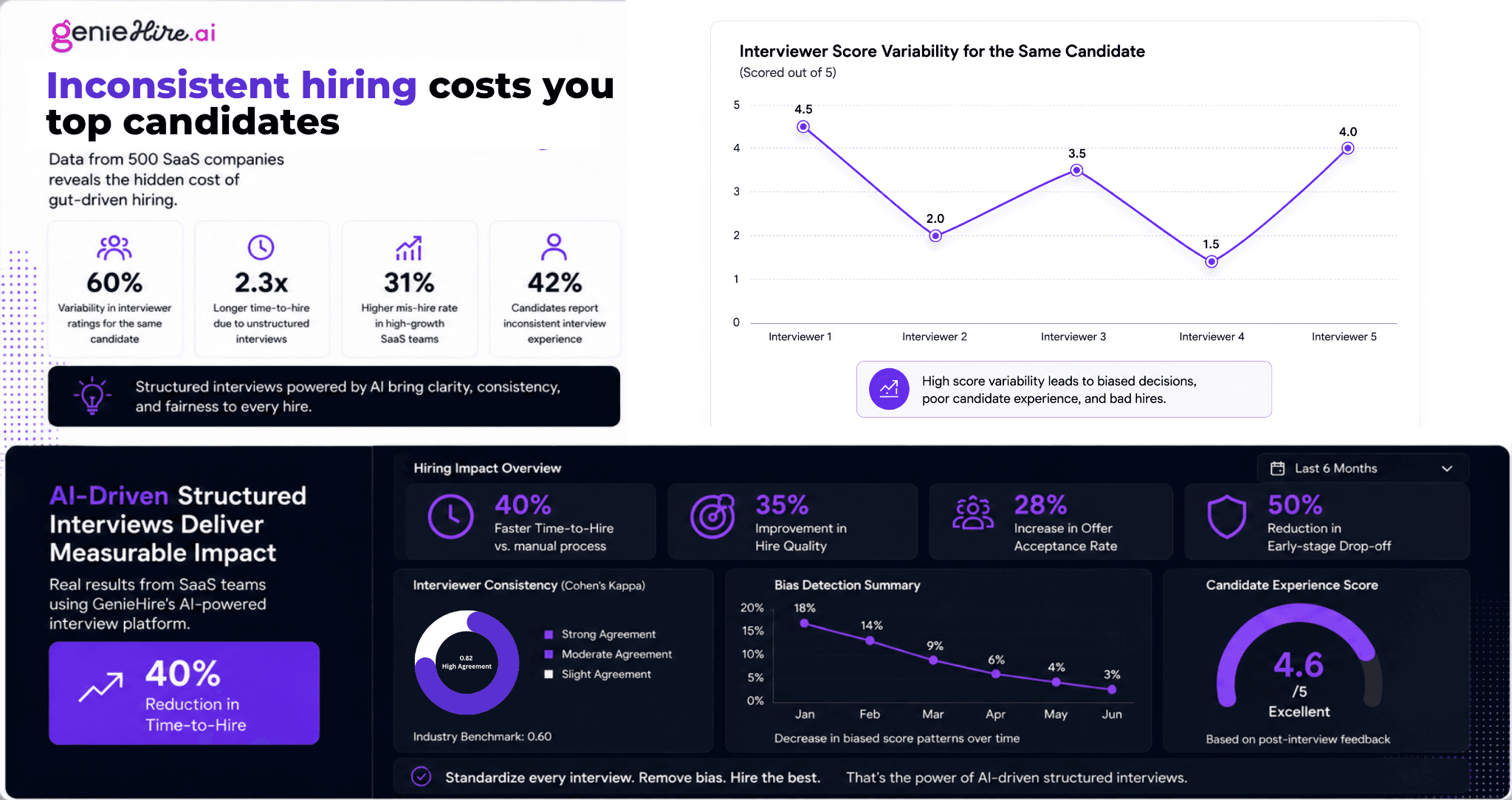
Gut-driven interviews create inconsistent, biased hiring decisions; two interviewers can walk away from the same candidate with opposite verdicts, especially across distributed teams.
A structured interview framework fixes this with six phases: job analysis, question development, scorecard design, interviewer training, consistent execution, and debrief/calibration.
AI-driven scheduling, proctoring, and bias analytics layer on top, automating coordination, securing final-stage assessments, and catching score drift early.
A strong scorecard template turns subjective answers into trackable, weighted metrics instead of gut calls.
Teams running this end-to-end with GenieHire saw time-to-hire drop by up to 40%, candidate satisfaction improve by over 25%, and offer acceptance rates rise by about 20% in one case study.
Two interviewers sit down with the same candidate, back to back, in the same thirty-minute slot.
One comes out and writes, "Strong hire, great culture fit." The other writes, "Weak communicator, pass." Nobody lied. They just asked different questions, weighted different things, and trusted a different gut.
That's not a bad-interviewer problem. That's what happens by default inside every SaaS team scaling across regions and time zones; good people making real hiring calls with no shared definition of what "good" even looks like.
This structured interview process guide shows how to standardize hiring with AI to achieve consistent, unbiased results.
Manual interviews often lead to inconsistent results and hidden bias, especially when scaling across regions. That's the promise of AI hiring done right: not replacing judgement but standardizing it.
We're sharing a step-by-step blueprint for automating each phase of your hiring sequence.
Check out: Ultimate Guide to Building an AI-Driven Hiring Process from Scratch for deeper implementation tactics.
Why Structured Interviewing Must Replace Gut-Driven Hiring
Relying on instinct amplifies bias and undercuts consistency across distributed teams.
Without structure, bias spikes when recruiters favor familiar accents or backgrounds, leading to inconsistent scoring. Panels waste time on unstructured debriefs, debating different questions and recall. Candidates facing random topics may view the process as arbitrary, harming your employer brand in new markets. This is exactly the gap that artificial intelligence in recruitment is built to close.
Once the risks of unstructured hiring are clear, the next step is understanding what a structured framework actually looks like in practice.
What Is a Structured Interview Framework?
An effective framework aligns each conversation to your predefined competencies and score metrics.
You establish a question bank rooted in core skills and map each query to behavioral indicators. This blueprint becomes your guarded playbook for every candidate. A structured framework includes standardized question sets tied to must-have skills and culture fit, scorecard rubrics that reduce evaluation variation, and competency mapping that connects questions directly to priority traits such as problem-solving and customer focus.
With that framework defined, here's how to put it into motion, phase by phase.
How to Build a Step-by-Step Structured Interview Process
Implement these phases to guarantee fairness and clarity at scale.
Skipping steps introduces hidden biases or leaves key skills untested. Follow all six phases to maintain rigor as you grow:
Job analysis: Define mission-critical skills, outcomes, and behavioral traits essential for success.
Question development: Draft and pilot structured questions, then refine based on pilot feedback.
Scorecard design: Build rating scales with clear descriptors for each performance level.
Interviewer training: Conduct calibration workshops to align on rubric use and mitigate drift.
Interview execution: Use plan-driven workflows so every interviewer asks the same sequence in the same format.
Debrief and calibration: After rounds, convene panels to compare scores and update your rubric for future rounds.
Once your phases are mapped out, the next question is where automation fits, starting with scheduling.
Who Benefits Most from AI-Driven Interviews? Scheduling Automation
High-volume and global teams free up hours each week by automating calendar coordination.
A head of talent at a mid-market SaaS company can offload routine scheduling across multiple time zones. Engineering squads avoid back-and-forth emails, securing slots within seconds. Volume recruiters who handle many candidates eliminate manual follow-ups and reduce no-shows by nearly half. This is where AI and recruitment overlap most directly; every hour saved in scheduling is an hour returned to sourcing and candidate care.
Scheduling automation solves the calendar problem. The next layer, proctoring and bias analytics solves the integrity problem.
When to Add Proctored Interviews and Bias Analytics
Timing your proctored sessions and analytics reviews ensures you intervene at the right moment.
Start bias monitoring after the first round of structured calls so you catch divergence early. Introduce AI-driven proctoring in final stages to verify candidate identity and secure code assessments. This balance preserves candidate trust while tightening screening integrity.
Early analytics: Review score distributions after round one to detect question bias patterns.
Proctored sessions: Deploy AI video proctoring for take-home tasks to safeguard IP.
Reporting cadence: Schedule bias reports weekly and adjust rubrics if any demographic skew emerges.
Feedback loops: Loop insights back to interviewers through real-time dashboards to correct drift on the fly.
Continuous audit: Refer to our AI-Driven Structured Interview Process Guide for full best practices on secure, unbiased sessions.
All of this data needs somewhere to live, which is exactly what a well-built scorecard template does.
What to Look for in an Interview Scorecard Template
A robust scorecard turns subjective answers into quantifiable metrics you can track over time.
Interviewers should have clear guidance on what distinguishes a strong answer from a weak one. Calibration notes help maintain inter-rater reliability above 0.8 in Cohen's kappa terms.
Defined rating levels: Numbered scales with explicit behavioral descriptors for each level.
Competency alignment: Sections for each core skill being evaluated.
Weighted scoring: Customizable weights so mission-critical skills impact the total score more heavily.
Automated summaries: Expect your platform to generate score breakdowns without manual data entry.
Calibration reminders: Scheduled prompts to recalibrate interviewers after every 10 interviews.
GenieHire's unified AI-driven platform seamlessly integrates AI resume screening, or 'what's increasingly called artificial intelligence resume screening', into a single workflow.
To explore pricing and plans, visit our Pricing page.
Real-World Examples of a Fully Integrated AI-Driven Workflow
See how two mid-market SaaS companies transformed their hiring engines with end-to-end AI orchestration.
Case study one: A collaboration software provider automated resume triage with AI models fine-tuned for SaaS competencies. They cut screening time by up to 70% and reduced reliance on external agencies. Interviews were then scheduled through an AI assistant that handled cancellations and follow-ups efficiently.
Case study two: A fintech scale-up introduced AI proctoring in second-round technical assessments. Pairing secure video sessions with bias analytics dashboards, they identified question sets that under-scored candidates. Refining their rubrics increased offer acceptance rates by about 20%. This is the kind of result that happens when artificial intelligence and recruitment strategy move together instead of in separate workflows.
These results are what happen when every phase works together instead of in isolation, which naturally raises a few common questions.
FAQs
What is a structured interview process?
A structured process uses predefined questions and scoring criteria. It requires interviewers to ask the same sequence of questions, each tied to key competencies. Rating scales with clear descriptors ensure consistency and reduce bias across panels and regions.
How do you create a structured interview guide?
Begin with a detailed job analysis and competency mapping exercise. Draft question banks aligned to core skills, then build a scorecard that quantifies responses. Pilot your guide in live interviews and refine based on interviewer feedback and performance data.
Why is structured interviewing important?
Structured methods minimize subjective bias and improve decision reliability. Teams following a systematic approach report faster debriefs, higher candidate satisfaction, and more accurate predictive validity of hires. Consistent data allows leaders to iterate and optimize question sets.
What are the steps in a structured interview process?
The six key phases run from role definition through calibration:
Start with job analysis, then
Develop questions and design your scorecard.
Next, train interviewers,
Conduct interviews uniformly, and finally
Hold debrief sessions to align on scores and update your framework.
How does AI improve structured interviews?
Automated resume screening shortlists relevant profiles, scheduling bots eliminate manual coordination, AI proctoring secures assessments, and bias analytics flag irregular score patterns. Combined, these capabilities scale hiring without sacrificing fairness.
Written by Dipleena Saikia, a content writer with 5 years of experience across tech, hiring, recruitment, and other domains. She researches and writes on emerging industry trends, helping readers stay ahead with clear, actionable insights.