|
20
min read

Most job descriptions do the opposite of what they're meant to do. They bury the role under a wall of jargon, list twenty "requirements" that scare off good candidates, and give hiring managers no real basis for comparing applicants fairly.
The result: fewer qualified people apply, and the ones who do get screened just by gut feeling instead of evidence.
This step-by-step guide breaks the process down into something repeatable. You'll get an outcome-focused structure for the job description itself, a language checklist that measurably improves response rates, and a pre-publication QA pass to catch bias before it shapes your shortlist.
What a Job Description Must Include
Every job description, regardless of role or seniority, needs three things to do its job well: a title and summary that's easy to find and understand, outcomes that tell candidates what success looks like, and qualifications that separate what's essential from what's merely nice to have.
Job title and summary: Pick a clear, searchable title, then follow it with a short paragraph that places the role in context, level, primary outcome, and team or function.
Stick to canonical title variants: Where you can use ("Software Engineer (Backend)" and "Marketing Manager, Growth" rather than internal shorthand.
Outcomes and key responsibilities: Lead with what success looks like, not a list of tasks.
Each responsibility should tie to a deliverable or metric; "increase lead conversion by 15%" tells a candidate far more than "responsible for lead generation".
Cap the role at three to five core outcomes, with two to four supporting details under each where useful.
Qualifications and competencies: Split required from preferred, and describe both in terms of what they let someone actually do in the job. A required qualification should be one that, without it, the person genuinely cannot perform the role safely or effectively, not just a credential that looks good on paper.
Why Competency-Based Job Descriptions Work Better
Swapping a long task list for a short set of outcomes and competencies isn't just a style choice; it changes how consistently you evaluate candidates. Vague task lists invite subjective interpretation at screening time; structured competencies map directly to interview questions and scoring rubrics, which makes assessment more reliable and less prone to bias.
The evidence backs this up. SHRM's guidance and Textio's research on job-post wording both point to measurable improvements in fairness and response rates when job descriptions are rebuilt around outcomes instead of duties. More employers are also pairing this rebuild with AI recruitment tools that scan and score a job description automatically, so the payoff for clean, structured writing compounds; a well-built job description doesn't just read better to a human, it also gets parsed and matched more accurately by AI recruitment software further down the funnel.
A Step-by-Step Guide to Structuring the JD
Start with a concise summary that states the role's purpose and top outcomes up front. Put your three most important role keywords in the title and within the first 150 words of the job description; this is what lets job boards and search engines match candidates to your posting. Skip internal jargon in favor of terms your industry actually searches for.
Step 1: Language and tone:
Write in active, plain language.
Cut gendered words and culturally specific idioms.
If the role allows for alternative career paths or learning on the job, say so explicitly; it widens your pool.
Where you can, turn absolute requirements into outcome-based competency statements and make room for candidates with transferable skills.
Textio's research shows this kind of wording change produces measurable shifts in who applies.
Step 2: Flexible qualifications:
Keep your true must-haves short.
Frame everything else as preferred or illustrative, and when you do ask for experience, describe the output you expect rather than leaning on years alone.
"Experience delivering cross-functional projects with visible stakeholder outcomes" tells candidates far more and screens out far less than "5+ years required".
Step 3: Keywords and phrasing:
Work three to five high-value keywords into the title and first 150 words of the job description, including common variants of the role title so both job boards and search engines can match candidate queries.
Leave out internal acronyms and niche terms an outside applicant won't recognize.
Step 4: Formatting for ATS parsing:
Use plain-text headings and standard date/location fields so applicant tracking systems, and the AI recruitment layer many of them now run on, can actually parse the job description.
Bullet your responsibilities and qualifications rather than burying them in paragraphs, and never embed the job description as an image or PDF; Google's job posting structured data guidance covers the technical side of this well.
Where and How to Post for Better Applicant Quality
Niche technical roles do better on specialized boards and communities; early-career roles do better through university career centers and alumni networks. Diversity-focused boards and partner organizations are worth the extra step if you're trying to widen the pool rather than just fill it faster.
If you don't have in-house recruiting bandwidth, searching "staffing agencies near me" is a reasonable starting point for roles that need to be filled fast; "local staffing agencies near me"-style searches tend to surface firms that already have a warmed-up candidate pipeline for common role types.

For harder-to-fill or highly technical searches, an AI recruitment platform can supplement a staffing agency by continuously matching your job description against passive candidates instead of waiting on inbound applications.
Disclose your salary where you can. It's increasingly required by law in many jurisdictions, but even where it isn't, transparency reliably increases both the volume and the quality of applications while reducing biased shortlisting. Indeed's guidance on salary disclosure lays out the data behind this.
Length and Format Guidance by Role Level
Length should scale with seniority, not with how much you feel like explaining. Keep summaries compact and expand only where the extra context earns its place.
Role Level | Summary Length | Total JD Length | Key Elements |
Individual Contributor | 150-300 words | 300-600 words | One-paragraph summary, 3 outcomes, competencies, logistics |
Senior / Lead | 200-350 words | 600-1,000 words | Context, 4-6 outcomes, leadership competencies, organization impact |
Executive | 200-400 words | 600-1,200 words | Strategy context, measurable goals, stakeholder map |
Structure for scannability: clear headings, short paragraphs, bullets for responsibilities and qualifications. Lead with what a candidate needs to decide whether to apply: role purpose, top outcomes, must-have skills, location, and salary band, and choose a readable font and spacing for your careers site.
Pre-Publication QA Checklist to Reduce Bias
Before any job description goes live, run it through a final bias check:
Inclusive language scan: Flag gendered words, cultural idioms, and unnecessary status signals against a consistent term list.
Document what you changed and why: An auditable record keeps language standards consistent across every hire, not just the ones someone happened to review carefully.
Qualification screen and shortlisting rules: Confirm every "required" qualification is genuinely role-critical; move the rest to preferred.
Decide your shortlisting rules: Which competencies are non-negotiable, and how transferable experience gets scored, before the first resume comes in, not after. Recording the rubric prevents ad-hoc exclusions later.
Iterate: After the first hiring round, check applicant quality against the job description and rubric, then adjust wording and competencies accordingly.
A job description is a living document, not a one-time draft.
Read more: Slash Hiring Costs: Why Saas Talent Execs Choose Full-stack AI Hiring in 2026
Job Description Examples
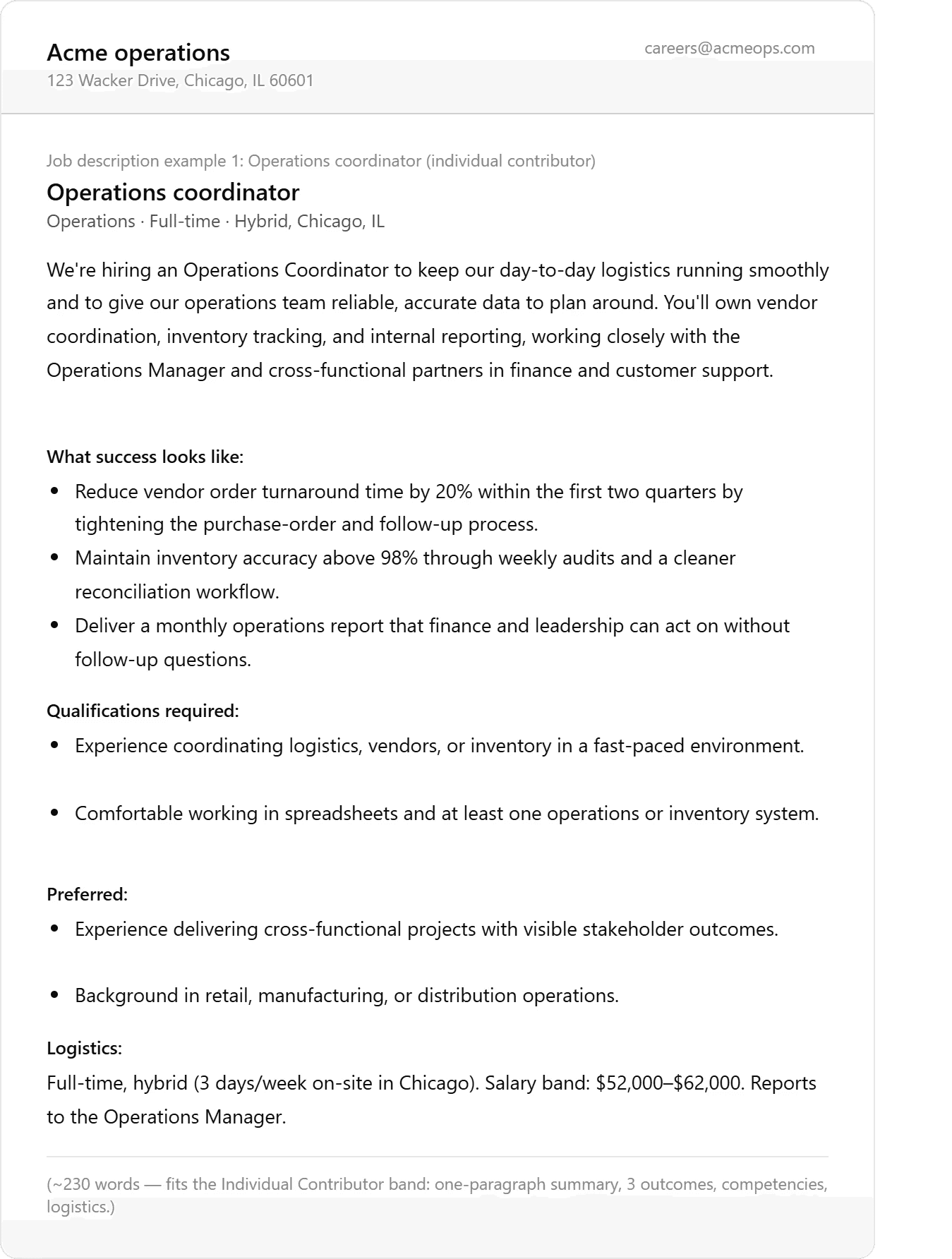
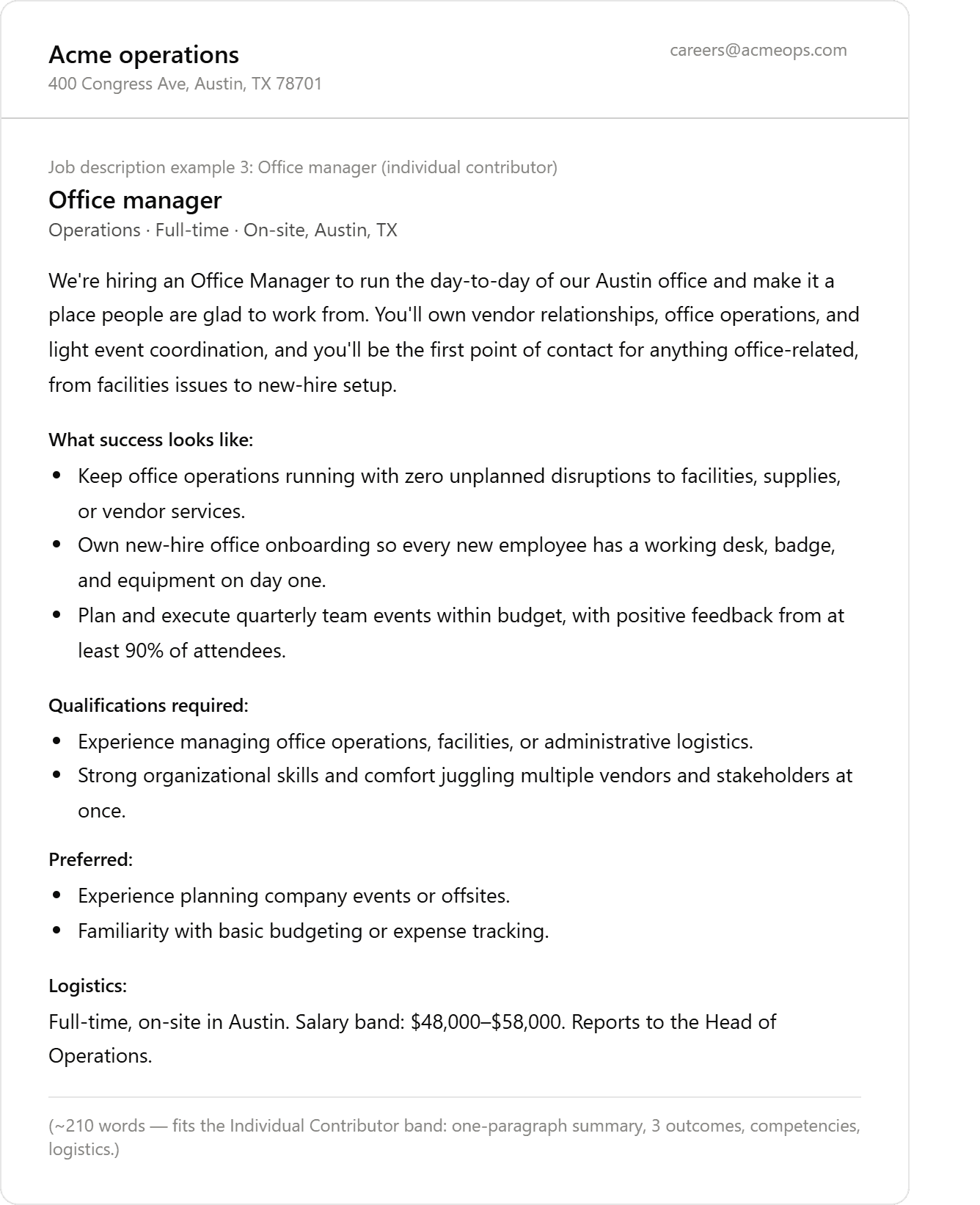
Here are some of the key job description examples to know of the mistakes that are hiding in plain sight:
Operations Coordinator
Senior Software Engineer, Backend

Office Manager
Key Takeaway
A strong job description leads with outcomes, not task lists; cap it at three to five core outcomes (four to six for senior/lead roles) tied to a metric or deliverable.
Split qualifications into required and preferred, and keep "required" limited to what's genuinely role-critical.
Match length to seniority using the role-level table: roughly 300-600 words for individual contributor roles, 600-1,000 for senior/lead, 600-1,200 for executive.
Work three to five keywords into the title and first 150 words so both job boards and the AI recruitment tools behind most ATS platforms can match candidates accurately.
Run every job description through the pre-publication QA checklist, inclusive language scan, qualification screen, and a plan to iterate after the first hiring round before it goes live.
Post where your candidates actually are: specialized boards for technical roles, university networks for early-career roles, and staffing agency 'near me'-style searches or an AI recruitment platform when you need to move fast or widen reach.
FAQs
What are the essential parts of a job description?
A clear title; a concise summary of role purpose and level, measurable outcomes or core responsibilities, technical and behavioral competencies, required versus preferred qualifications, and logistics; location, hours, employment type, and salary band.
How detailed should responsibilities in a JD be?
Outcome-focused and concise: three to five primary outcomes, with supporting detail only where it's needed. Skip long task lists that don't tie back to a measurable result.
How do I write qualifications without discouraging applicants?
Limit "required" to what's genuinely essential for safe, effective performance. Frame the rest as preferred. Replace years-of-experience requirements with competency or outcome statements, and explicitly welcome transferable skills and nontraditional backgrounds.
Should I include salary in a job description?
Yes, wherever possible. Salary ranges increase application rates, reduce biased shortlisting, and are legally required for many roles depending on jurisdiction. Listing a band signals transparency and helps candidates self-select accurately.
How can I make a job description more inclusive?
Use inclusive language, drop unnecessary barriers like strict degree or year requirements, signal flexibility where it exists, and describe competencies in outcome-based terms. A consistent checklist for flagging gendered terms and cultural idioms, paired with an openness to transferable skills, does most of the work.
Written by - Dipleena Saikia
A content writer with 5 years of experience across Tech, Hiring, and Recruitment, and other domains. She researches and writes on emerging industry trends, helping readers stay ahead with clear, actionable insights.